
- Empty cart.
- Continue Shopping
Cannabis and Wellness: What Science Is Discovering
- Posted on
Kinnabis
- 0
- Categories: Wellness Wensday
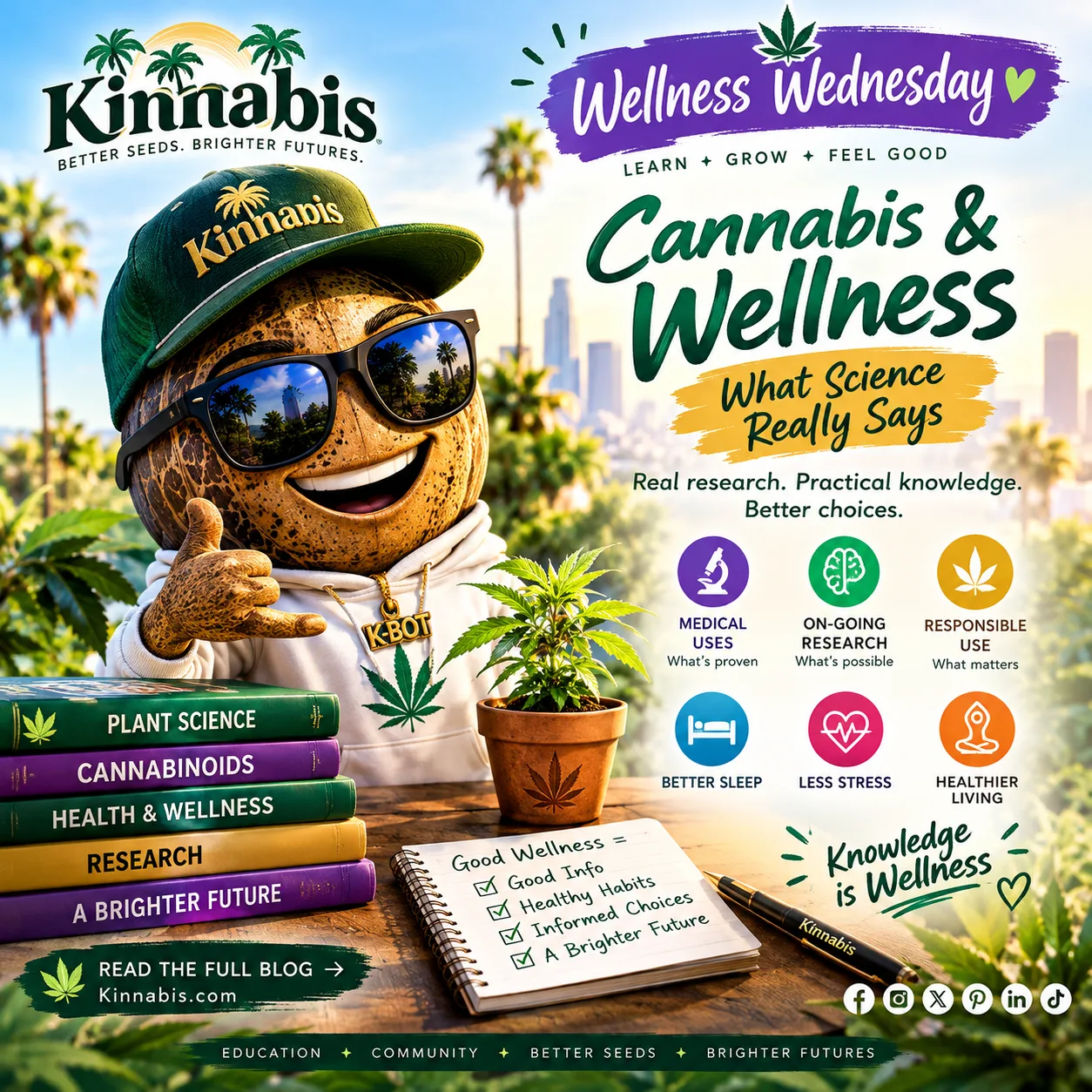
Cannabis and Wellness: What Science Really Says About the Plant and Your Well-Being
Wellness is about making informed choices, understanding your body, and separating scientific evidence from the hype. Here’s what current research tells us about cannabis.
Wellness means different things to different people. For some, it means getting better sleep. For others, it’s managing stress, staying physically active, nurturing relationships, or finding a healthier balance in everyday life.
And then there’s cannabis—a plant that has attracted growing scientific interest because of its many chemical compounds and their interactions with the human body.
But let’s get one thing straight: understanding cannabis and wellness requires more than repeating popular claims. It requires looking at what research actually supports, what remains uncertain, and how responsible choices fit into the bigger picture of health.
This Wellness Wednesday, we’re exploring the science behind cannabis, cannabinoids, and well-being.
1. Cannabis research is more specific than you might think
Cannabis contains a diverse collection of chemical compounds. Two of the best-known cannabinoids are tetrahydrocannabinol (THC) and cannabidiol (CBD).
THC is primarily responsible for the intoxicating effects associated with cannabis. CBD does not produce the same typical intoxicating effect, but that doesn’t automatically make it risk-free.
Scientists study these compounds because they interact with biological systems involved in functions such as pain signaling, appetite, and other processes.
However, the effects of a particular compound depend on several factors, including its formulation, dose, the person taking it, and the condition being studied.
That is why research findings about one cannabinoid medicine cannot automatically be applied to every cannabis product.
The National Center for Complementary and Integrative Health explains that the evidence varies considerably depending on the health condition and the specific cannabinoid preparation being evaluated.
In other words, cannabis science isn’t one single conclusion. It’s a growing body of research with different findings for different applications.
2. The encouraging news: some cannabinoid medicines have established medical uses
One of the most important developments in cannabinoid research is that certain medicines containing cannabinoids have received approval for specific medical conditions.
For example, the U.S. Food and Drug Administration has approved Epidiolex, a prescription medicine containing purified CBD, for seizures associated with certain rare forms of epilepsy and tuberous sclerosis complex.
Certain prescription medicines containing dronabinol or nabilone, which act on cannabinoid pathways, are also approved for specific uses involving chemotherapy-related nausea and vomiting. Dronabinol has additional approved uses for appetite and weight loss in people with HIV/AIDS.
These are meaningful medical applications.
They also illustrate why scientific precision matters: the evidence supporting a particular prescription medicine for a defined condition does not establish that every cannabis product will provide the same benefit.
The cannabis plant itself has not received FDA approval as a treatment for general wellness.
The good news is that cannabinoid science has already produced useful medical treatments—and researchers continue to investigate where additional evidence may lead.
3. What about pain, sleep, and everyday wellness?
These are among the subjects that generate the most questions about cannabis.
The evidence, however, is mixed and depends on the condition being studied.
Chronic pain
Some clinical research suggests that certain cannabis-based medicines may provide modest relief for some forms of chronic pain. Benefits must be weighed against side effects, and findings from specific formulations do not necessarily apply to products available in other settings.
People living with persistent pain should discuss treatment options with a qualified healthcare professional rather than assume cannabis will work for them.
Sleep
Cannabinoids have been studied in people experiencing sleep difficulties associated with conditions such as chronic pain and multiple sclerosis.
Some studies have reported improvements in certain sleep-related outcomes. However, it can be difficult to determine whether these changes result directly from cannabinoids or from improvements in the underlying symptoms.
Evidence supporting cannabis or CBD as a general treatment for sleep disorders remains insufficient.
Stress and emotional well-being
Wellness includes emotional health, but it is important not to confuse a person’s subjective experience with proof of a medical benefit.
Some people report that cannabis affects how they feel. Others experience unwanted anxiety, disorientation, or paranoia.
Research has not established cannabis as a universal solution for stress or mental health concerns. Anyone experiencing persistent anxiety, depression, or other mental health symptoms deserves appropriate professional support.
The lesson? An individual’s experience can be worth discussing, but it is not a substitute for reliable evidence.
4. Wellness isn’t just about what you take
Here’s a point that can get lost in conversations about cannabis: a healthy lifestyle involves much more than any one plant, supplement, or product.
The National Center for Complementary and Integrative Health describes wellness as having several dimensions, including emotional well-being, satisfying relationships, physical activity, healthy food choices, and sleep.
Those foundations matter regardless of whether cannabis is part of someone’s life.
Consider a few practical steps:
- Protect your sleep. Maintain a consistent sleep schedule and create a comfortable environment for rest.
- Move your body. Choose physical activities suited to your abilities and health needs.
- Nourish yourself. Eat a balanced diet and stay appropriately hydrated.
- Make room for connection. Healthy relationships and social support contribute to emotional well-being.
- Know your limits. Be honest about how substances affect your behavior, responsibilities, relationships, and health.
Cannabis should never be treated as a replacement for these foundations or as a reason to delay appropriate medical care.
5. Responsible cannabis use is part of an honest wellness conversation
A positive conversation about cannabis must also acknowledge the risks.
THC can affect memory, attention, judgment, coordination, and reaction time. Cannabis use can also produce unpleasant psychological effects, and frequent use may lead to cannabis use disorder in some people.
Smoking cannabis can harm lung tissue. Cannabis can affect heart rate and blood pressure, and its use may pose additional risks for people with certain medical conditions.
Cannabis should not be used during pregnancy or breastfeeding. Young people face particular risks because the brain continues developing into early adulthood.
Anyone who chooses to use cannabis should understand local laws, product contents, possible interactions with medications, and individual health considerations. Do not drive or operate machinery while impaired.
Keep cannabis products securely stored away from children and pets.
If you’re taking prescription medications or managing a health condition, talk with a healthcare professional about potential interactions and risks.
Responsible choices are not the opposite of enjoying cannabis culture. They are part of respecting the plant, yourself, and the people around you.
6. How to separate cannabis science from marketing hype
As interest in cannabis grows, so does the volume of wellness claims.
A product might be advertised as supporting relaxation, improving sleep, reducing inflammation, or addressing a long list of other concerns. But a confident marketing statement does not establish that a product works.
When evaluating a health claim, ask:
Was the claim studied in humans? Laboratory research can help scientists understand biological mechanisms, but a finding in cells or animals does not automatically predict a benefit in people.
What exact product was studied? Evidence from a purified prescription medicine cannot automatically be transferred to an unstandardized extract, flower, or consumer product.
Was the research well designed? Study size, comparison groups, duration, and reproducibility all influence how much confidence researchers can place in a result.
What were the risks? A possible benefit must be considered alongside adverse effects and interactions.
Who conducted or funded the research? Funding does not automatically invalidate findings, but transparent methods and independent replication help strengthen confidence.
These questions are useful far beyond cannabis. They are essential tools for anyone navigating today’s wellness marketplace.
7. The future of cannabis wellness depends on better knowledge
Cannabis research continues to investigate cannabinoids, their biological mechanisms, and their potential applications.
Scientists are examining different compounds, formulations, and conditions. Some questions have clearer answers than others, and many areas still need better clinical evidence.
That uncertainty shouldn’t lead us to dismiss every possible benefit. Nor should promising early findings be presented as established treatments.
A thoughtful approach makes room for both scientific progress and honest limits.
The future of cannabis wellness will be better served by careful research, responsible product information, appropriate medical guidance, and consumers who know how to ask good questions.
Final thoughts: knowledge is part of wellness
At Kinnabis, we believe education belongs in the cannabis conversation.
The plant is scientifically interesting. Cannabinoids have already contributed to important medical treatments, and ongoing research may help clarify additional applications.
But real wellness is bigger than any single product. It involves informed decisions, healthy routines, meaningful relationships, and knowing when professional medical guidance is needed.
This Wellness Wednesday, take a moment to invest in something that always pays off: knowledge.
Learn what the evidence says. Question exaggerated claims. Respect your health. And remember that making informed choices is a powerful part of taking care of yourself.
Kinnabis — better seeds, brighter futures.
Further reading and scientific sources
- National Center for Complementary and Integrative Health: Cannabis (Marijuana) and Cannabinoids: What You Need to Know
- National Center for Complementary and Integrative Health: Wellness and Well-Being
- Centers for Disease Control and Prevention: Cannabis Health Effects
Educational information only. This article is not medical advice and does not recommend cannabis as a treatment for any condition. Consult a qualified healthcare professional about personal health concerns.