
- Empty cart.
- Continue Shopping

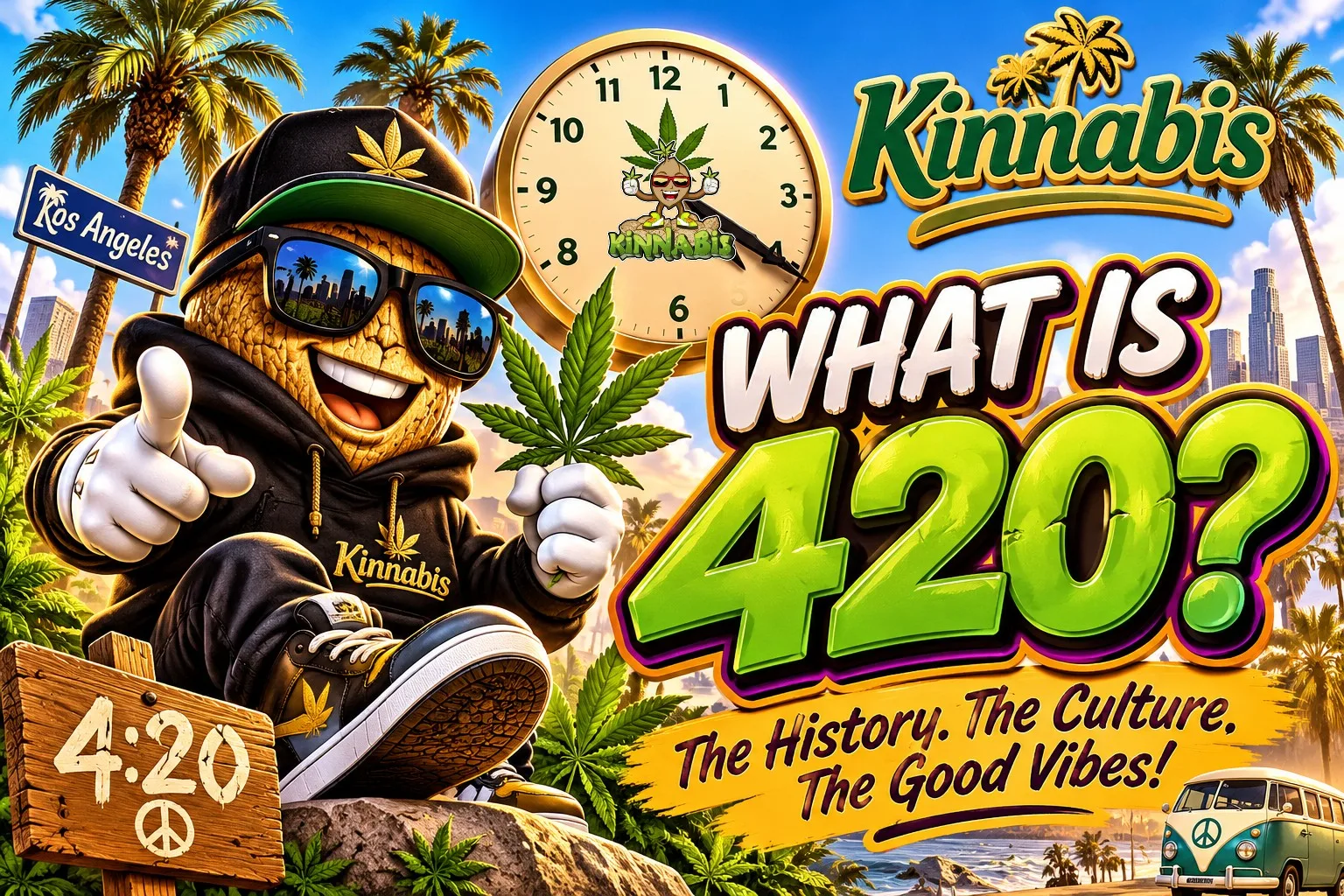
420: The Number That Became a Cannabis Legend
From a Secret High School Code to a Worldwide Celebration of Cannabis Culture
Let’s talk about 420.
You’ve seen it on T-shirts, heard it in conversations, spotted it on calendars, and probably noticed that every April 20, cannabis enthusiasts around the world suddenly have something in common.
But have you ever stopped to ask yourself: What exactly is 420, and how did three little digits become such a big deal?
Well, grab your favorite snack, get comfortable, and let’s take a little trip back in time. Because the real story behind 420 is even more interesting than some of the stories people have been passing around!
Welcome to 420, Kinnabis style. 😎
So, What Exactly Is 420?
In cannabis culture, 420 (pronounced four-twenty) is a popular expression associated with cannabis.
It represents a time of day, a date on the calendar, and an entire culture built around a shared appreciation for the cannabis plant.
Here’s how it works:
- 4:20 PM: A traditional time associated with cannabis culture.
- April 20 (4/20): The unofficial international cannabis holiday.
- 420 Culture: A broader expression of cannabis community, education, celebration, and shared history.
Every year on April 20, cannabis enthusiasts gather for events, festivals, educational discussions, music, and celebrations.
Some celebrate the plant. Others celebrate the culture. And plenty simply enjoy being part of a community that recognizes the number.
But here’s the million-dollar question: Where did it all begin?
Let’s rewind the clock!
The Real History of 420: Five Friends, One Wall, and a Secret Code
<em>Location: San Rafael, California. Year: 1971.</em>
Picture this.
It’s the early 1970s. Bell-bottoms are fashionable, rock music is booming, and five high school friends have a little secret.
They call themselves The Waldos.
Why? Because they regularly hung out by a wall outside San Rafael High School in Marin County, California.
The group consisted of Steve Capper, Dave Reddix, Jeffrey Noel, Larry Schwartz, and Mark Gravitch.
Now, these weren’t five students sitting around trying to invent the next big cultural phenomenon. They were just friends looking for something interesting to do.
And then came the treasure hunt.
According to the Waldos’ story, they heard about a cannabis crop near Point Reyes that had supposedly been abandoned by a Coast Guardsman who could no longer tend to it.
Naturally, the boys thought this sounded like an adventure!
They arranged to meet after school at a statue of Louis Pasteur near their campus.
What time?
You guessed it.
4:20 PM.
They began reminding one another throughout the school day by saying, “4:20 Louis.”
Eventually, they shortened it to simply “4:20.”
They would meet, head out in search of the mysterious cannabis plants, and enjoy their adventures along the way.
There’s just one little problem.
They never found the plants!
That’s right. The legendary treasure hunt didn’t exactly have a successful ending. But something much bigger came out of it.
A secret code was born.
And those five friends had absolutely no idea how far those three numbers would travel.
How 420 Went From a California Secret to a Worldwide Phenomenon
Here’s where the story gets even better.
The Waldos had connections to the music scene surrounding the legendary Grateful Dead.
Through family and personal connections, the expression began circulating among people associated with the band and its followers, commonly known as Deadheads.
And if you know anything about the Grateful Dead, you know their following wasn’t exactly small!
The phrase gradually traveled through concert communities, music circles, and cannabis enthusiasts.
Then came an important moment.
In December 1990, a flyer circulated among Grateful Dead fans in Oakland, California, inviting people to gather at 4:20 on April 20 for a cannabis-related celebration.
A reporter named Steve Bloom, who worked with High Times magazine, came across the flyer.
The magazine subsequently published it in 1991.
That exposure helped take 420 beyond its original California circles and introduce it to a much wider audience.
Before long, the number was becoming part of cannabis culture across the country and eventually around the world.
A few high school friends had accidentally started something legendary.
Talk about leaving a mark!
Let’s Clear Up Some 420 Myths!
Over the years, plenty of interesting theories have circulated about where 420 came from.
Some sound convincing. Others sound like somebody got a little too creative with their history homework.
Let’s separate fact from fiction.
Myth #1: 420 Is a Police Radio Code for Marijuana.
Nope!
This is probably the most famous misconception. Although the police-code explanation appeared on an early flyer that helped spread the term, there is no credible evidence that 420 originated as a police code for cannabis.
The Waldos’ documented history points to their after-school meeting time in 1971.
Myth #2: Cannabis Contains Exactly 420 Chemical Compounds.
Nice try, science!
Cannabis contains hundreds of chemical compounds, including cannabinoids, terpenes, and flavonoids. The number varies depending on what is being measured and identified.
There is no magic 420-compound rule.
Myth #3: 420 Came From Bob Dylan’s Music.
Some people connect the number to Bob Dylan’s song “Rainy Day Women #12 & 35.”
Their theory? Multiply 12 by 35 and you get 420.
Interesting math, but there is no reliable historical evidence connecting the song to the origin of the term.
Myth #4: April 20 Is the Birthday of the Cannabis Plant.
Wouldn’t that be convenient?
Unfortunately, April 20 isn’t the official birthday of cannabis. The date became associated with the culture through the expression 420 and its evolution into an annual celebration.
The real history is already pretty entertaining. We don’t need to make up a birthday!
Why April 20 Became Cannabis Culture’s Unofficial Holiday
Today, April 20 is recognized internationally as a day associated with cannabis culture.
Depending on where you are, celebrations can include:
- Cannabis education and community events.
- Music festivals and live entertainment.
- Cannabis history and advocacy discussions.
- Conversations about responsible adult use.
- Celebrations of cannabis-related art, culture, and entrepreneurship.
But 420 has also grown into something bigger than a once-a-year gathering.
It represents decades of changing attitudes, conversations about cannabis policy, scientific research, and the development of a worldwide industry.
For some, it’s a day of celebration. For others, it’s an opportunity to discuss legalization, access, social equity, and the future of cannabis education.
And that’s worth recognizing.
420 and the Changing Cannabis Landscape
Think about how much has changed since five friends started using a secret code in California.
Back in 1971, cannabis carried significant legal risks across the United States.
Today, cannabis laws have changed considerably in many states, although federal and state laws still differ, and cannabis remains federally controlled.
Research has expanded. Public conversations have become more sophisticated. Cannabis businesses have developed new products, and consumers have become increasingly interested in understanding genetics, cultivation, cannabinoids, and plant science.
There’s still plenty of work to do.
Education matters. Responsible conversations matter. And understanding the plant beyond the popular culture is just as important as knowing the history behind the number.
At Kinnabis, we believe the cannabis conversation should include more than catchy slogans and celebrations.
It should include learning, curiosity, research, community, and positive growth.
After all, knowledge is always a good thing to cultivate!
The Kinnabis Take: 420 Is More Than a Number!
Here’s what we love about the 420 story.
Five friends in California created a little secret code to meet after school. They went looking for something they never found, but their little adventure helped inspire a cultural movement recognized around the world.
That’s quite a story!
And it reminds us that sometimes the biggest things start with the smallest ideas.
Whether you’re interested in cannabis history, genetics, growing techniques, plant science, or simply learning something new, there’s always another chapter to explore.
So, the next time somebody mentions 420, you’ll know there’s a whole lot more behind those three numbers than meets the eye.
And remember, you don’t have to wait until April 20 to learn something new about cannabis.
Every day is a good day to grow your knowledge!
Happy 420, everybody!
Stay curious. Keep learning. Keep growing.
Kinnabis — Planting Positive Seeds. 🌱
Educational note: This article is intended for adults 21+. Cannabis laws vary by location. Always follow applicable laws and make informed, responsible decisions. Never drive while impaired.