
- Empty cart.
- Continue Shopping

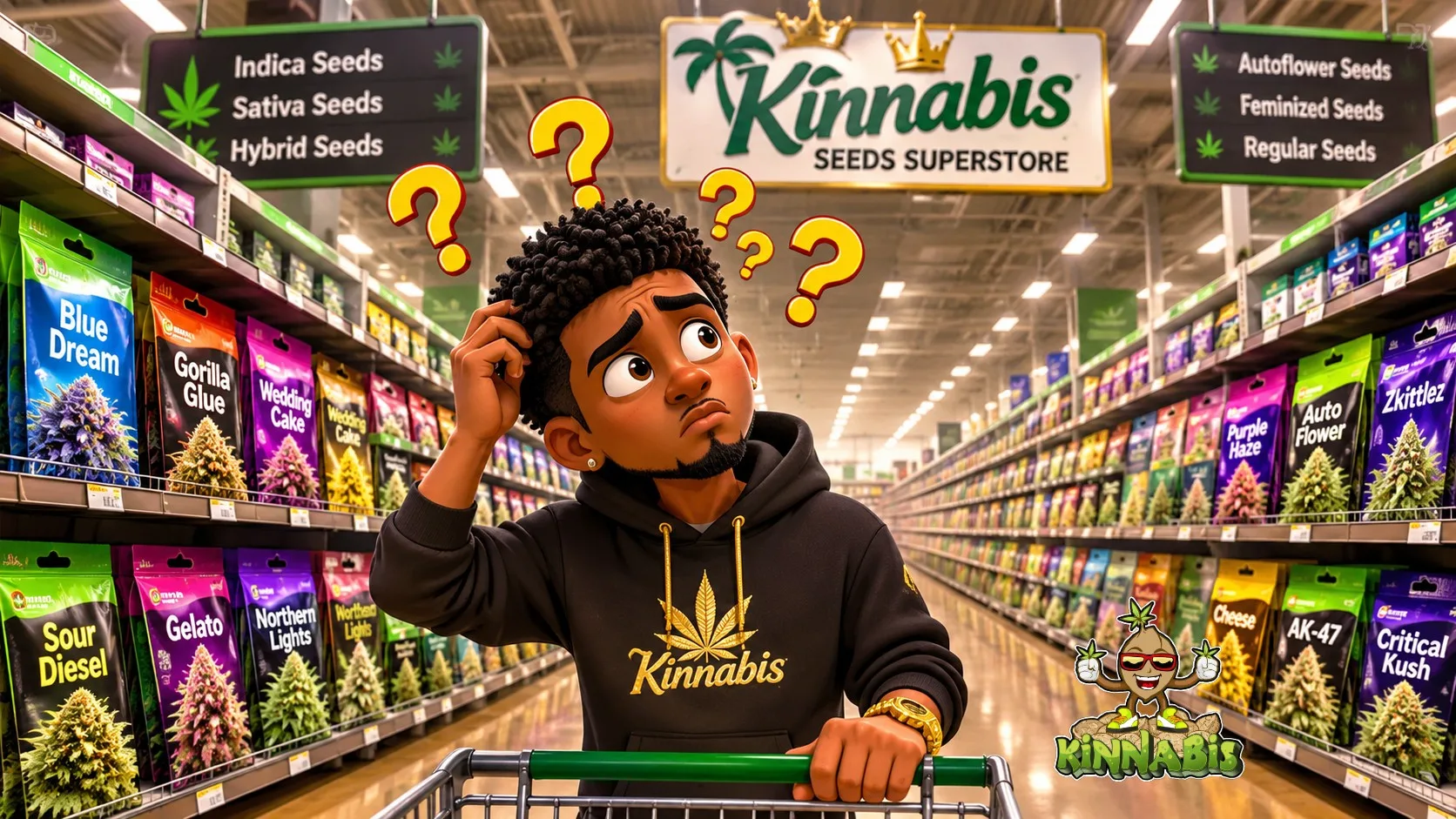
How to Find the Right Cannabis Strain for You: A No-Nonsense Guide to Making the Right Choice
With thousands of cannabis strains available, how do you know which one is right for you? Here’s how to look beyond the names, understand strain descriptions, and make a smarter choice.
Walk into a cannabis seed store, browse an online seed catalog, or start researching cannabis strains, and one thing becomes immediately clear: there are A LOT of choices.
Fruity names. Dessert names. Gas names. Purple names. Strains promising incredible flavors, impressive THC percentages, massive yields, and experiences that sound almost too good to be true.
Blue Dream. Sour Diesel. Wedding Cake. Gelato. Northern Lights. Gorilla Glue.
And that’s just scratching the surface.
So where do you begin?
How do you know whether a strain is right for you? What should you look for in a strain description? Does THC percentage really matter? Should beginners choose Indica or Sativa? And how do you separate useful information from clever marketing?
Let’s get into it.
The truth is that finding the right cannabis strain takes a little homework. But once you understand what you’re looking at, choosing becomes a whole lot easier.
1. Start With What You Want, Not the Strain Name
Here’s the first mistake many people make: they fall in love with a strain name before they understand what they’re buying.
A name might sound delicious, exciting, powerful, or downright irresistible. But a creative name doesn’t tell you everything about the plant.
Before you start browsing, ask yourself a few questions:
- Are you interested in a strain with a particular aroma or flavor?
- Are you looking for a more relaxing or uplifting experience?
- Are you interested in a lower-THC option?
- Are you shopping for seeds to grow at home?
- Are you looking for a manageable plant or an advanced growing challenge?
- Do you have limited growing space?
- Are you interested in a particular flowering time or harvest size?
These questions help narrow the playing field.
Kinnabis Tip: Don’t shop for a strain just because everybody else is talking about it. Popularity doesn’t automatically mean compatibility.
2. Understand the Difference Between Indica, Sativa, and Hybrid
You’ve probably seen these three categories everywhere.
Indica. Sativa. Hybrid.
Traditionally, cannabis has been classified into these three groups, but here’s something worth understanding: these labels don’t reliably predict exactly how a particular strain will make you feel.
Modern cannabis genetics are complicated. Many commercial strains have mixed ancestry, and their effects can vary considerably.
Still, these categories can provide some historical and botanical context.
Indica: Traditionally associated with shorter, bushier plants and broader leaves.
Sativa: Traditionally associated with taller plants, narrower leaves, and longer flowering periods.
Hybrid: A cross involving different cannabis genetic lines, often combining characteristics from both.
But don’t stop there.
Two strains labeled Indica can produce very different experiences. Two Sativa-labeled strains can also be remarkably different.
The smarter move? Look at the actual genetics, cannabinoid profile, terpene information, and available product or breeder data.
Don’t let three little words make your entire decision.
3. Learn to Read a Cannabis Strain Description
This is where things get interesting.
A strain description is more than a paragraph designed to make a plant sound attractive. When properly written, it should help you understand what you’re considering.
Let’s break down the information you should look for.
THC Percentage
THC, or tetrahydrocannabinol, is the primary intoxicating cannabinoid in cannabis.
You’ll frequently see strain descriptions advertising THC percentages such as 15%, 20%, 25%, or even higher.
But here’s the unadulterated truth:
A higher THC percentage does not automatically mean a better cannabis experience.
THC percentage tells you the measured concentration of THC under particular testing conditions. It does not tell you everything about the experience, the aroma, the flavor, or how an individual will respond.
Also, a breeder’s advertised THC figure is not necessarily a laboratory-verified result for every plant grown from those seeds.
Look for actual testing information when available.
If you’re new to cannabis, don’t automatically chase the highest number. Higher-potency products can increase the likelihood of unwanted effects such as anxiety, dizziness, and impaired coordination.
CBD Percentage
CBD, or cannabidiol, is another major cannabinoid found in cannabis.
Unlike THC, CBD is not intoxicating in the same way.
Some strains are bred to contain substantial amounts of CBD, while others have very little.
If CBD content matters to you, look for documented cannabinoid testing rather than relying on a strain name or marketing description.
Terpenes: The Aroma and Flavor Story
Now we’re talking about one of the most interesting parts of cannabis.
Terpenes are aromatic compounds found in cannabis and many other plants. They’re responsible for much of the distinctive smell and flavor associated with different varieties.
Here are some common examples:
Myrcene: Often associated with earthy, musky, and herbal aromas.
Limonene: Commonly associated with citrus aromas.
Pinene: Associated with pine-like aromas.
Caryophyllene: Often described as peppery, spicy, or woody.
Linalool: Associated with floral and lavender-like aromas.
Terpenes are worth paying attention to, especially if aroma and flavor are important to you.
However, don’t fall for the idea that one terpene guarantees a particular effect. Research into how individual terpenes influence the overall cannabis experience is still developing.
The complete chemical profile matters more than any single compound.
Flowering Time
If you’re buying seeds, flowering time is important.
It gives you an estimate of how long a photoperiod cannabis plant may take to flower after entering its flowering stage.
For example:
- 7–8 weeks: A relatively short advertised flowering period.
- 9–10 weeks: A common flowering window.
- 11–12 weeks or longer: A longer flowering period.
These are estimates, not promises.
Actual timing depends on genetics, growing conditions, phenotype, and the breeder’s reporting methods.
If you’re working with limited time or space, flowering time should be part of your decision.
Expected Yield
Every grower wants a good harvest. Nothing wrong with that!
But don’t let an impressive yield number be the only reason you choose a strain.
Breeder yield estimates are generally based on particular growing conditions. Indoor and outdoor estimates may differ substantially.
Pay attention to whether the breeder provides:
- Indoor yield estimates.
- Outdoor yield estimates.
- Expected plant height.
- Flowering time.
- Environmental requirements.
A strain advertised as a heavy producer may not perform that way in every garden.
Remember: genetics provide potential. Growing conditions influence performance.
4. Know What Kind of Seeds You’re Buying
Not all cannabis seeds are created for the same growing approach.
When browsing a seed catalog, you’ll commonly encounter three categories.
Feminized Seeds
Feminized seeds are bred to produce female plants with a much higher likelihood than regular seeds.
Female cannabis plants are generally the ones cultivated for cannabinoid-rich flowers.
These seeds are popular among growers who want to avoid identifying and removing unwanted male plants.
However, feminized does not mean every seed is guaranteed to develop perfectly. Genetics and environmental conditions still matter.
Autoflowering Seeds
Autoflowering varieties flower according to their developmental age rather than relying on a change in daylight hours to initiate flowering.
They’re often attractive to growers looking for a more straightforward growing schedule.
Their compact size and relatively quick life cycle can also make them appealing in certain growing environments.
But don’t assume every autoflower is automatically easy or produces a small harvest. Genetics and growing conditions matter.
Regular Seeds
Regular seeds can develop into either male or female plants.
They are often selected by breeders and growers interested in working with genetic variation, breeding projects, and traditional cannabis genetics.
If you’re simply looking for a more predictable starting point, understand the differences before purchasing.
Kinnabis Tip: Know what you’re buying before you buy it. Feminized, autoflowering, and regular seeds serve different purposes.
5. Research the Genetics and Breeder
Here’s something that doesn’t get enough attention.
The breeder matters.
A strain name alone doesn’t tell you the complete genetic story. Different breeders may work with different versions of a named strain, and similarly named varieties aren’t necessarily genetically identical.
Look for information about:
- The strain’s parent genetics.
- The breeder’s reputation.
- Whether the genetic lineage is documented.
- Whether the breeder provides consistent descriptions.
- Whether independent growers have documented their experiences.
- Whether the advertised characteristics are supported by actual information.
Be particularly careful with claims that sound extraordinary.
If somebody promises guaranteed 30% THC, enormous yields, perfect flavor, and effortless growing, ask where the evidence is.
Good genetics matter, but honest information matters too.
6. Consider Your Growing Environment
If you’re purchasing cannabis seeds, your environment deserves serious consideration.
A strain that performs beautifully in one setting may struggle in another.
Think about your available space, climate, temperature, humidity, airflow, and whether you’re growing indoors or outdoors.
Some varieties naturally grow taller than others. Some have longer flowering periods. Others may be more sensitive to environmental changes.
Before purchasing, investigate:
- Expected plant height.
- Indoor or outdoor suitability.
- Flowering duration.
- Environmental sensitivity.
- Mold and disease susceptibility, where reliable information is available.
- Whether the variety is appropriate for your experience level.
A beginner doesn’t necessarily need the most complicated genetics in the catalog.
Sometimes the smartest decision is choosing something manageable and learning the fundamentals first.
7. Don’t Believe Everything You Read About a Strain
Let’s have a little Real Talk From The Grow Room.
Cannabis marketing can get creative.
You’ll see descriptions promising:
- The strongest strain ever.
- The most flavorful flowers on Earth.
- Guaranteed enormous yields.
- Incredible effects every single time.
- The ultimate beginner strain.
Some descriptions contain useful information. Others are mostly sales language.
Learn to recognize the difference.
For example, a statement such as “flowers in 8–9 weeks” gives you something measurable to investigate.
A statement such as “the most incredible experience you’ll ever have” is an opinion.
And remember: individual experiences with cannabis vary. A strain that one person loves might not agree with another person at all.
Read descriptions, compare breeders, look for laboratory testing, and investigate independent grow reports.
Don’t confuse advertising with evidence.
8. Start With Your Experience Level
If you’re new to cannabis, don’t feel pressured to purchase the strongest or most expensive option.
Cannabis can affect people differently, and THC potency is not a competition.
If you’re choosing a product to consume, consider starting with a lower-THC option, avoiding high-potency concentrates, and using a very small amount if you choose to consume. Allow sufficient time for effects before considering more.
For inhaled cannabis, effects can begin quickly, but they may continue developing. Edibles can take considerably longer to take effect.
Avoid combining cannabis with alcohol, don’t drive while impaired, and keep cannabis products away from children and pets.
If you’re choosing seeds, focus on manageable genetics, documented characteristics, and a growing approach that matches your experience.
There’s no prize for making your first grow unnecessarily difficult.
9. Compare Three Strains Before Making Your Decision
Here’s a simple trick that can save you from making an impulsive purchase.
Instead of falling in love with the first strain you see, select three candidates.
Create a little comparison chart.
| What to Compare | Strain A | Strain B | Strain C |
|---|---|---|---|
| Breeder | |||
| Genetic lineage | |||
| Seed type | |||
| Flowering time | |||
| Expected height | |||
| Expected yield | |||
| THC information | |||
| CBD information | |||
| Terpene profile | |||
| Growing difficulty | |||
| Price |
Now compare the information.
Which one has the genetics you’re interested in?
Which one fits your available space?
Which breeder provides the most useful information?
Which one offers the best combination of characteristics for your goals?
You might discover that the most popular strain isn’t actually your best option.
That’s what informed shopping is all about.
10. The Truth About Finding Your Perfect Strain
Here’s something every cannabis enthusiast should understand:
There may not be one perfect strain.
Your preferences can change. Your experience can change. Your interests can change.
The strain you enjoy today might not be the strain you enjoy six months from now.
Even seeds from the same genetic line can show some variation in plant characteristics. Environmental conditions can also influence the final expression of the plant.
That’s why experienced growers pay attention to genetics, phenotypes, environmental conditions, and documented results.
And if you’re choosing cannabis to consume, remember that individual responses are not perfectly predictable. No strain name, THC number, or terpene combination can guarantee a particular experience.
The goal isn’t to find a magical plant that promises everything.
The goal is to make an informed decision based on what you actually want.
The Kinnabis Bottom Line: Shop Smart, Grow Smart, Stay Curious!
There are thousands of cannabis strains out there, and new genetic combinations continue to enter the market.
Don’t let the choices overwhelm you.
Start with your goals. Understand the difference between seed types. Read strain descriptions carefully. Research the breeder. Look beyond THC percentages. Pay attention to terpenes, flowering times, plant characteristics, and documented growing information.
And most importantly, don’t let clever marketing make your decisions for you.
At Kinnabis, we believe education should come before the purchase.
We’re not interested in simply selling you a seed. We want you to understand what you’re buying, why you’re buying it, and what information you should look for before making your decision.
Because a smarter grower starts with a smarter choice.
Kinnabis: A Seed Bank That Plants Positive Seeds.
Explore. Learn. Compare. Grow Your Knowledge.
Disclaimer: Cannabis laws vary by location. Always follow applicable local and state laws. Cannabis is intended for adults of legal age only. Cannabis use carries health risks, including impairment and dependence. This educational article is not medical advice.