
- Empty cart.
- Continue Shopping
🏷️ How To Read a Cannabis Seed Label
Understanding What’s on the Pack Before You Grow
You finally found a strain that caught your eye.
The packaging looks fire. The photos look amazing.
But then you see things like:
- THC %
- Indica / Sativa
- Flower Time
- Feminized
- Autoflower
- Yield
- Genetics
…and suddenly it feels like another language.
Don’t worry.
At Kinnabis, we’re breaking it all down simple.
Because understanding a seed label helps you:
- Choose the right strain
- Avoid beginner mistakes
- Know what to expect before you grow
Let’s decode the pack.
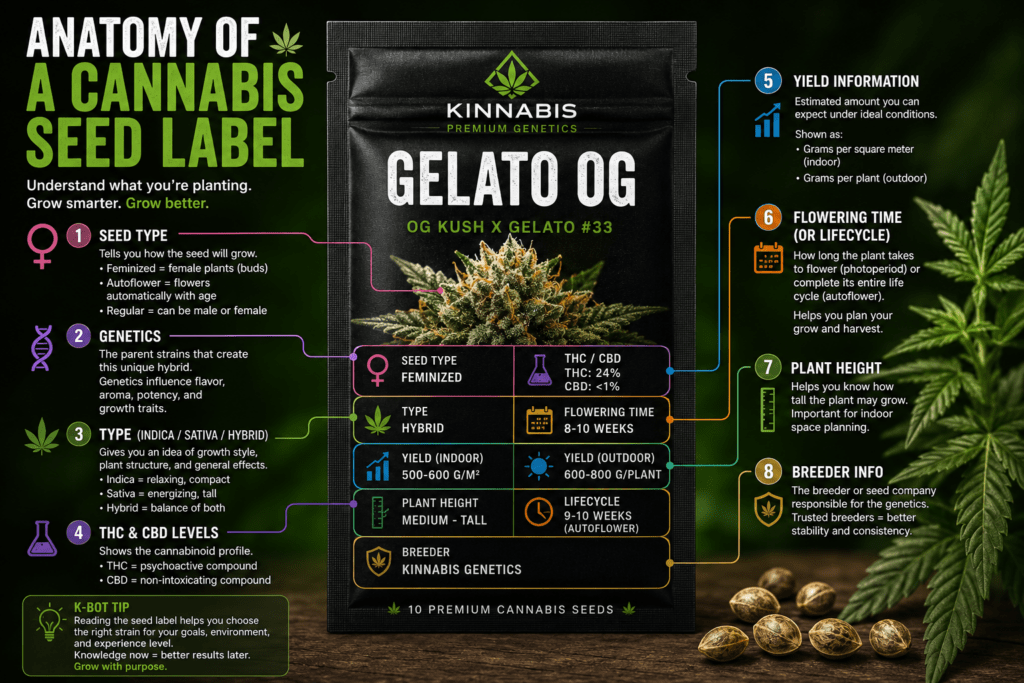
🌱 1. Seed Type
The First Thing You Should Look At


Most seed packs will say:
- Feminized
- Autoflower
- Regular
This tells you how the plant grows.
Quick Breakdown:
- Feminized → Produces female bud-producing plants
- Autoflower → Flowers automatically with age
- Regular → Can produce male or female plants
👉 If you’re new, feminized or autoflower seeds are usually easiest.
🧬 2. Genetics
The Plant’s Family Tree
Seed labels often show the strain’s genetics.
Example:
OG Kush × Gelato
This means the strain was bred using those parent plants.
Genetics influence:
- Flavor
- Aroma
- Potency
- Plant size
- Growth style
- Effects
💡 Kinnabis Insight:
Great genetics are the blueprint behind great cannabis.
🔥 3. THC & CBD Levels
What the Plant Is Known to Produce


Most labels list:
- THC %
- CBD %
Example:
- THC: 24%
- CBD: <1%
This gives you a general idea of the plant’s cannabinoid profile.
Important:
THC and CBD percentages are estimates — not guarantees.
Results depend on:
- Grow environment
- Lighting
- Nutrients
- Harvest timing
- Grower skill
🌿 4. Indica, Sativa, or Hybrid
The Plant’s Growth & Experience Style
You may see:
- Indica
- Sativa
- Hybrid
General Breakdown:
- Indica → Compact plants, relaxing traits
- Sativa → Taller plants, energetic traits
- Hybrid → Combination of both
⚠️ Modern Reality:
Most strains today are hybrids in some form.
These labels are more about:
- Growth tendencies
- Breeding background
- General experience expectations
⏱️ 5. Flowering Time
How Long the Plant Takes to Finish
Most seed labels include:
- Flower time (for photoperiod plants)
- Total lifecycle (for autoflowers)
Examples:
- Flowering Time: 8–10 weeks
- Autoflower Lifecycle: 9 weeks from seed
This helps growers plan:
- Harvest timing
- Grow cycles
- Space management
📦 6. Yield Information
How Much the Plant May Produce
Labels often show:
- Indoor yield
- Outdoor yield
Example:
500g/m² indoor
This is an estimate based on:
- Ideal conditions
- Proper lighting
- Experienced cultivation
💡 Kinnabis Insight:
Yield numbers are possibilities — not promises.
The grower matters just as much as the genetics.
📏 7. Plant Height
Important for Indoor Growers
Some strains stay short and compact.
Others stretch tall.
This matters if you grow:
- Indoors
- In tents
- In limited vertical space
Example:
- Short / Compact → Better for small setups
- Tall / Stretchy → Needs more room and training
🌎 8. Breeder Information
Who Created the Genetics
Many packs include the breeder name.
This tells you:
- Who developed the strain
- Reputation of the genetics
- Breeding consistency
Trusted breeders usually provide:
- Better stability
- Better germination rates
- More accurate strain information
🔥 Final Word from Kinnabis
A cannabis seed label is more than packaging…
it’s the roadmap for your entire grow.
Once you learn how to read the pack,
you stop guessing — and start growing smarter.
FAQ 1
What does feminized mean on a seed label?
Feminized seeds are bred to produce female cannabis plants, which are the plants that grow buds.
FAQ 2
What does flowering time mean?
Flowering time is the estimated number of weeks a cannabis plant takes to mature and produce harvest-ready buds.
FAQ 3
What is THC percentage on cannabis seeds?
THC percentage estimates the potency potential of the cannabis strain under ideal growing conditions.
FAQ 4
What does hybrid mean on a seed label?
Hybrid means the strain contains both indica and sativa genetics.