
- Empty cart.
- Continue Shopping
Cannabis Generation Types: Understanding Landraces, F1, F2, R1, BX and Beyond

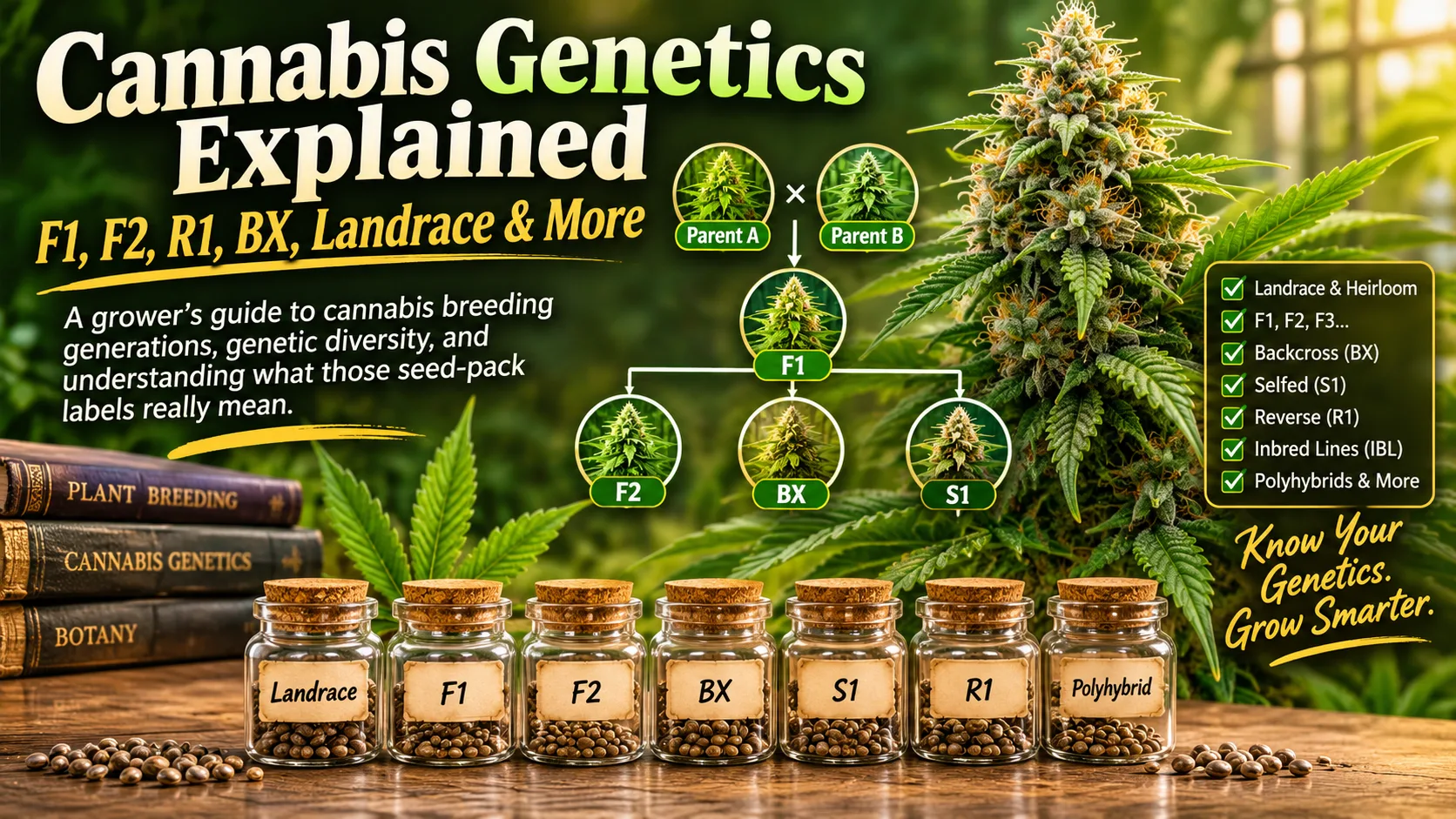
Cannabis Generation Types: Understanding Landraces, F1, F2, R1, BX and Beyond
1. First, what exactly is a cannabis generation?
Before we get into the individual classifications, let’s establish one important concept.
A cannabis generation refers to a stage in a plant’s breeding history. It helps describe how offspring were produced from previous generations or parental selections.
Think of it like a family tree.
Every new generation carries inherited genetic information from its parents. However, offspring don’t necessarily receive identical combinations of that information. During sexual reproduction, genetic material is recombined, and different offspring can express different combinations of inherited traits.
This is why two seeds from the same strain can sometimes produce noticeably different plants.
One may grow shorter and bushier, while another stretches taller. One might express stronger fruit aromas, while its sibling leans toward earthy, fuel-like characteristics.
They share a genetic history, but they aren’t necessarily identical.
Understanding generations helps explain why this happens.
There is another important distinction: not every term on a cannabis seed package describes a generation. Some describe geographic origins, breeding methods, population structures, or reproductive characteristics.
Let’s separate those categories.
2. Landrace genetics: Where the story begins
A landrace is a geographically associated population of cannabis that developed and was maintained over generations in a particular region.
Long before modern seed banks, commercial hybrids, and today’s elaborate strain names, cannabis populations were adapting to their local environments.
Over time, natural selection and human cultivation helped shape populations with characteristics suited to their surroundings.
Examples commonly associated with traditional cannabis regions include:
-
Afghan: Associated with Afghanistan and surrounding Central Asian regions.
-
Hindu Kush: Associated with the mountainous regions of Afghanistan and Pakistan.
-
Thai: Associated with Southeast Asia and tropical growing environments.
-
Durban: Associated with South Africa.
-
Malawi: Associated with southeastern Africa.
These populations became important genetic resources for modern cannabis breeding.
What makes landrace genetics interesting?
Landrace populations can contain valuable genetic diversity.
Depending on their history, they may carry traits associated with:
-
Different flowering characteristics.
-
Distinctive aromatic profiles.
-
Plant architecture and branching.
-
Environmental adaptation.
-
Different cannabinoid and terpene expressions.
-
Variations in growth patterns.
However, a landrace isn’t automatically genetically uniform. A regional population may contain considerable variation between individual plants.
This is important because growers sometimes assume that purchasing landrace seeds means every plant will look and perform exactly alike.
That isn’t necessarily the case.
How this applies to your grow program:
Landrace genetics are particularly interesting to growers and breeders who value genetic diversity, historical genetics, and discovering unusual phenotypes.
If your goal is to preserve genetic diversity or explore characteristics that may be less common in modern commercial hybrids, landrace-derived genetics can be worth investigating.
One more distinction: a modern cross between two landrace populations is a hybrid. It doesn’t become a landrace simply because its parents came from traditional growing regions.
3. Heirloom genetics: Preserving a piece of history
You’ll often see the term heirloom used alongside landrace.
Although the terms are sometimes used interchangeably in the cannabis industry, they aren’t necessarily the same thing.
An heirloom cultivar generally refers to genetics that have been maintained and passed down over time, often outside their original geographic environment.
For example, a cannabis population originating in a particular region may have been brought elsewhere, cultivated for many years, selected, and preserved by growers.
It may retain much of its original genetic identity while developing a separate cultivation history.
Think of heirloom genetics as a piece of living agricultural history.
Why should growers care?
Heirloom genetics can offer:
-
Historical cultivar preservation.
-
Distinctive genetic backgrounds.
-
Interesting plant characteristics.
-
Access to genetics that may be less common in modern commercial breeding.
For growers interested in preservation, heirloom genetics offer a connection to the history of cannabis cultivation.
4. F1: The first filial generation
Now we’re getting into the generation terminology you’ll frequently encounter when shopping for cannabis seeds.
F1 stands for First Filial Generation.
It represents the first generation of offspring produced from two parental sources.
Here’s the basic concept:
The F1 Generation
Parent A
First genetic source
Parent B
Second genetic source
First cross
F1
First filial generation
Offspring of the two parental sources
For example, a breeder crosses two selected cultivars:
Cherry cultivar × Gelato cultivar = F1 offspring.
The resulting offspring inherit genetic material from both parental sources.
But here’s where things get interesting.
Does F1 mean every plant will be identical?
Not necessarily!
This is one of the biggest misconceptions surrounding cannabis genetics.
In commercial agriculture, F1 hybrids are often developed from highly inbred parental lines. When those parents are genetically uniform, their offspring can exhibit impressive consistency.
Cannabis breeding doesn’t always follow that model.
If two parents are genetically diverse, their F1 offspring can still show variation.
An F1 label tells you the generation, not automatically how uniform the plants will be.
What about hybrid vigor?
You may also hear the term heterosis, commonly called hybrid vigor.
This describes a situation where offspring demonstrate improved characteristics compared with their parents.
Depending on the genetics, this may include:
-
Increased vigor.
-
More robust growth.
-
Improved uniformity.
-
Greater biomass.
-
Better performance for certain selected traits.
Research published in HortScience in 2024 examined cannabis inbred lines and their F1 hybrids. The researchers found that certain F1 combinations demonstrated greater uniformity and improved growth and flower production compared with the parental lines.
This is an important example of how carefully developed parental genetics can influence the performance of their offspring.
HortScience Journals
How this applies to your grow program:
If you’re looking for a hybrid with documented consistency, investigate the parental lines and the breeder’s selection history.
Don’t purchase an F1 simply because the label sounds impressive. Ask what the breeder used to create it.
5. F2: Where genetic variation becomes especially interesting
If F1 is the first generation, F2 is the second filial generation.
An F2 population is generally produced by crossing F1 offspring with one another.
The simplified breeding relationship looks like this:
F1 offspring
Selected individuals from the first generation
F1 plant A
F1 plant B
F2
Second filial generation
A new generation with recombined genetic combinations
Why is this important?
Because the F2 generation can reveal a wider range of genetic combinations.
Traits that were less visible or hidden in the F1 generation may become more apparent in the F2.
For example, imagine a breeder working with two parental lines:
-
Parent A contributes a compact growth structure.
-
Parent B contributes a particular aromatic profile.
The F1 offspring may express a combination of both.
But when F1 plants are bred together, the F2 generation can produce offspring with different combinations of inherited traits.
Some may resemble Parent A more closely. Others may resemble Parent B. Some may express combinations that weren’t obvious in the F1 population.
This process is called genetic segregation.
Why F2 genetics matter
F2 populations are particularly valuable in breeding and selection because they can expose additional genetic diversity.
A breeder may discover a standout phenotype that becomes the foundation for another breeding project.
For a grower, this means an F2 population may offer interesting variation, but it may also be less predictable than a carefully developed, uniform hybrid.
How this applies to your grow program:
If consistency is your top priority, investigate how much variation the breeder reports in the F2 population.
If you’re interested in genetic exploration, phenotype discovery, and understanding how different traits express themselves, F2 genetics can be particularly interesting.
6. F3, F4, F5 and beyond: Developing a line over generations
As breeding continues through F3, F4, F5, and subsequent generations, breeders have additional opportunities to select plants carrying desirable characteristics.
Each generation provides another opportunity for selection and refinement.
For example:
| Generation | General breeding stage |
|---|---|
| F1 | First offspring generation |
| F2 | Second filial generation |
| F3 | Third filial generation |
| F4 | Fourth filial generation |
| F5 | Fifth filial generation |
| F6+ | Later generations |
As a breeder advances a population, they may select for characteristics such as:
-
Plant structure.
-
Flowering characteristics.
-
Aroma and terpene expression.
-
Cannabinoid profiles.
-
Resin characteristics.
-
Environmental response.
-
Consistency between offspring.
However, here’s something worth remembering:
A higher generation number does not automatically mean better genetics or greater stability.
The results depend on the breeding method, the number of plants involved, the selection criteria, and the genetics being worked with.
A population advanced through several generations without meaningful selection isn’t necessarily more uniform than a carefully selected earlier generation.
The work behind the number matters.
7. BX: Understanding backcross genetics
BX stands for Backcross.
Backcrossing is a breeding method in which offspring are crossed back toward one of their original parental sources, known as the recurrent parent.
Why would a breeder do this?
Imagine a breeder has a particular cultivar with an exceptionally desirable characteristic. They cross it with another cultivar to introduce an additional trait.
The offspring may inherit desirable characteristics from both parents, but they may also express traits the breeder doesn’t particularly want.
Backcrossing allows the breeder to work toward recovering more of the recurrent parent’s genetic background while retaining the selected characteristic introduced by the other parent.
Understanding BX1 and BX2
Here’s a simplified example:
How a backcross works
Original Parent A + Parent B
Initial cross
Initial offspring
Selected offspring carrying the desired trait
BX1
Selected offspring crossed back toward Parent A
BX2
Selected BX1 offspring crossed back toward Parent A again
Each additional backcross represents another breeding step toward the recurrent parent.
Under simplified Mendelian assumptions, the expected average proportion of the recurrent parent’s nuclear genetic contribution is:
| Breeding stage | Expected recurrent-parent contribution |
|---|---|
| Initial cross | 50% |
| BX1 | 75% |
| BX2 | 87.5% |
| BX3 | 93.75% |
| BX4 | 96.875% |
These are theoretical averages, not guarantees for an individual seed. Actual inheritance varies, and selection, linkage, and the breeding population all matter.
Why backcrossing matters
Backcrossing can help breeders:
-
Recover characteristics associated with a particular parent.
-
Introduce selected traits into an existing genetic background.
-
Work toward a more specific genetic expression.
-
Refine a breeding line over multiple generations.
How this applies to your grow program:
When you see BX1, BX2, or BX3 on a seed description, look at which parent the breeder was attempting to recover.
A BX3 isn’t automatically superior to a BX1. The important question is whether the breeder successfully retained the desired characteristics while developing the line.
8. S1: Selfed genetics explained
S1 stands for First Selfed Generation.
Selfing occurs when a plant’s own genetic material supplies both sides of the reproductive cross.
In cannabis breeding, this is commonly accomplished by using pollen from a genetically female plant that has been induced to produce functional pollen.
The basic relationship is:
Plant A × reversed Plant A = S1
Why do breeders use this method?
One reason is to explore the genetic variation carried within a particular plant.
Although a selected plant may display desirable characteristics, it can still carry genetic variants that aren’t immediately visible.
Selfing allows those inherited variants to recombine, sometimes revealing unexpected characteristics in the offspring.
Does S1 produce clones from seeds?
No.
This is another important misconception.
A clone is a vegetatively propagated copy of the original plant’s genotype.
An S1 seed is produced through sexual reproduction. Even though both genetic contributions come from the same source genotype, genetic recombination means the offspring are not necessarily identical to the original plant.
Some S1 offspring may resemble the original selection closely, while others may express different characteristics.
Why S1 genetics can be valuable
Breeders may use S1 populations to:
-
Explore a desirable clone’s genetic background.
-
Develop feminized seed lines.
-
Reveal recessive characteristics.
-
Identify offspring resembling a selected source plant.
-
Begin further breeding and selection.
How this applies to your grow program:
If you purchase S1 seeds from a highly regarded clone selection, don’t assume every plant will be a carbon copy of that original clone.
Look for information about how the breeder evaluated the S1 offspring and whether the line was further selected.
9. R1: Another generation you’ll encounter
R1 is a particularly interesting term because its use isn’t completely standardized throughout the cannabis seed industry.
Some breeders use R1 to identify a first-generation feminized cross involving two different female genetic sources, with one serving as the reversed pollen donor.
For example:
Female A × reversed Female B = R1
In this context, R1 helps distinguish the feminized cross from an S1, where the same genotype supplies both genetic contributions.
An R1 can also be described biologically as a first filial generation because it is the first offspring generation from two distinct parental sources.
However, not every breeder uses R1 identically.
Some use it as a commercial designation for a reversal-derived release rather than a strict pedigree description.
R1 versus S1
| Classification | General parentage |
|---|---|
| S1 | Plant A × reversed Plant A |
| R1 | Female A × reversed Female B |
The distinction is important because the genetic relationship between the parents is different.
How this applies to your grow program:
When purchasing R1 genetics, look beyond the label. Find out whether the breeder used two distinct parental selections, what those parents were, and what the R1 designation means in that breeder’s catalog.
A clear pedigree is more useful than an unexplained abbreviation.
10. IBL: Inbred lines and genetic consistency
IBL stands for Inbred Line.
An IBL is a breeding population developed through repeated related breeding and selection with the goal of increasing genetic consistency.
This can involve successive generations of selfing, crossing related plants, or other breeding approaches.
The objective is to reduce unwanted variation and increase the likelihood that offspring consistently express selected characteristics.
However, there isn’t one universal generation number that automatically makes a cannabis cultivar an IBL.
You may hear breeders associate IBL development with F5, F6, or later generations, but the actual degree of uniformity depends on the breeding history.
Why IBL genetics matter
For growers who value consistency, well-developed inbred lines can be particularly useful.
A breeder may have spent multiple generations selecting for:
-
Predictable plant structure.
-
Consistent flowering characteristics.
-
Specific aroma profiles.
-
Desired cannabinoid characteristics.
-
More uniform offspring.
One caution: excessive inbreeding can also reduce vigor or expose undesirable recessive characteristics.
The goal isn’t simply to increase the generation number. It’s to develop a healthy population with predictable traits.
11. Polyhybrids: When multiple genetic backgrounds come together
A polyhybrid is a hybrid cultivar or breeding population with a more complex genetic background, typically involving multiple hybrid lineages.
For example:
A × B = Hybrid 1
C × D = Hybrid 2
Hybrid 1 × Hybrid 2 = Polyhybrid offspring
Polyhybrids are common in modern cannabis breeding.
They can bring together genetic contributions from several cultivars, creating a broader combination of inherited traits.
This can produce interesting diversity, but it can also make offspring more difficult to predict.
What should growers expect?
Depending on the parents and breeding history, polyhybrid populations may show variation in:
-
Growth structure.
-
Flowering time.
-
Aroma.
-
Resin characteristics.
-
Plant size.
-
Cannabinoid expression.
A complex lineage isn’t necessarily a bad thing.
It simply means growers should pay attention to the breeder’s selection history and documented consistency.
12. Other terms worth knowing
Generation terminology doesn’t stop with F1, F2, BX, and S1.
Here are a few additional classifications worth recognizing.
| Term | Meaning |
|---|---|
| P1 / P2 | Identifies parental sources in a breeding project |
| BC | Another abbreviation for backcross |
| BC1F1 | First filial generation following the first backcross |
| S2 | Second selfed generation |
| S3 | Third selfed generation |
| RBX | Often used for reverse or feminized backcrossing; breeder terminology varies |
| OP | Open-pollinated population |
| IBL | Inbred line |
| F1 Polyhybrid | First filial cross involving hybrid parental backgrounds |
| Stabilized | A breeder’s claim of increased consistency for selected traits |
Remember that terms such as R1, RBX, and stabilized can vary between breeders. Always investigate the actual breeding history rather than assuming every seed bank uses identical terminology.
13. Generation Types at a Glance
Let’s bring everything together.
| Classification | What it tells you | What to remember |
|---|---|---|
| Landrace | Geographic population history | May contain considerable diversity |
| Heirloom | Preserved historical genetics | History and preservation matter |
| F1 | First filial generation | Uniformity depends on parents |
| F2 | Second filial generation | More trait segregation may appear |
| F3–F6+ | Later filial generations | Selection history matters |
| BX | Backcross | Works toward a recurrent parent |
| S1 | First selfed generation | Not genetically identical clones |
| R1 | Common feminized outcross designation | Breeder usage varies |
| IBL | Inbred line | Consistency depends on development |
| Polyhybrid | Multiple hybrid backgrounds | May contain considerable variation |
14. How to use generation information when choosing seeds
Now let’s bring this information out of the genetics textbook and into the grow room.
Knowing the generation of a cannabis seed can help you make a more informed purchasing decision.
It gives you clues about the breeding history, potential variation, and what questions you should ask before selecting a cultivar.
Here are four things worth considering.
A. Determine what you’re trying to accomplish
Every grower has different priorities.
Some want consistency. Others enjoy discovering unusual phenotypes. Some are interested in preserving genetics, while others simply want to explore different cultivars.
Your goal should influence the genetics you select.
| Your priority | What to investigate |
|---|---|
| Consistency | Selection history and documented uniformity |
| Exploring phenotypes | F2 and diverse breeding populations |
| Preserving genetics | Landrace and heirloom populations |
| Specific parental traits | BX breeding history |
| Exploring a particular clone | S1 lineage and source selection |
| Established breeding lines | Documented IBL development |
| Modern hybrid combinations | F1 and polyhybrid parentage |
These are starting points, not guarantees. A carefully selected F2 may be more consistent than a poorly documented F1.
B. Read the breeder’s description carefully
Don’t stop at the strain name.
Look for the following information:
-
What are the parent cultivars?
-
Is the generation identified?
-
Does the breeder explain the breeding process?
-
Is the cultivar feminized or regular?
-
Is it photoperiod or autoflowering?
-
Has the breeder discussed phenotype variation?
-
Is there information about selection and stabilization?
A breeder who provides meaningful lineage information gives you a better starting point for understanding what you’re purchasing.
C. Keep a grow journal
This is one of the most underrated tools in cannabis cultivation.
If you’re growing different generations or genetic backgrounds, record what you observe.
Your journal can include:
-
Cultivar and breeder.
-
Generation designation.
-
Seed identification.
-
Plant structure.
-
Flowering characteristics.
-
Aroma observations.
-
Environmental conditions.
-
Phenotype differences.
-
Final evaluation.
Over time, these records can help you recognize which genetic backgrounds consistently deliver the characteristics you value.
You aren’t just growing plants. You’re building knowledge.
D. Don’t confuse generation with growing performance
A seed marked F5 isn’t automatically better than an F2.
An S1 isn’t automatically more predictable than an F1.
A landrace isn’t automatically more resilient than a modern hybrid.
Growing performance is influenced by genetics, environmental conditions, plant health, and cultivation practices.
Generation information helps explain the genetic background. It doesn’t replace good cultivation practices or reliable breeder information.
15. Important distinctions: Generation isn’t the same as seed type
There’s one final detail worth understanding.
Cannabis seed descriptions frequently combine several classifications.
For example, a seed might be described as:
F1 Feminized Photoperiod Hybrid
Each part tells you something different.
| Description | What it tells you |
|---|---|
| F1 | First filial generation |
| Feminized | Seed is produced through a breeding process intended to yield female plants |
| Photoperiod | Flowering is responsive to changes in the light cycle |
| Hybrid | Genetic background combines different parental sources |
Similarly, an autoflowering cultivar can be F1, F2, or another generation.
Feminized, regular, photoperiod, and autoflower are not generation classifications.
They describe other aspects of the seed or plant.
Understanding this distinction helps prevent confusion when comparing cultivars.
16. Questions to ask your seed breeder
If you want to become a more informed cannabis seed buyer, start asking better questions.
Here are seven questions that can help you understand the genetics behind a product.
-
What are the original parental cultivars?
-
What generation is this particular release?
-
Was the line developed through filial breeding, selfing, or backcrossing?
-
How much phenotype variation should growers expect?
-
Has the breeder selected for specific characteristics over multiple generations?
-
Is the generation designation based on a documented pedigree or breeder-specific terminology?
-
Are there any known characteristics that distinguish this generation from earlier releases?
You don’t need a genetics degree to ask these questions.
You just need to understand what you’re purchasing.
Final Thoughts: Better Genetics Knowledge Makes Better Growers
Cannabis genetics are fascinating because every cultivar has a story.
Behind every seed is a combination of inherited characteristics, parental selections, breeding decisions, and generations of genetic development.
Landraces introduce us to the historical diversity of cannabis. F1 and F2 generations help us understand how traits are inherited and recombined. BX breeding gives breeders a way to work toward particular parental characteristics. S1 and R1 classifications help explain different reproductive relationships. IBL development focuses on increasing consistency through continued breeding and selection.
But here’s the biggest lesson:
Don’t judge cannabis genetics by the generation number alone. Understand the story behind the number.
A knowledgeable grower doesn’t simply ask whether a seed is F1, F2, BX, or S1. They ask what those classifications mean for the particular genetics they’re considering.
The more you understand the relationship between breeding history and plant characteristics, the better equipped you are to make informed decisions.
Because successful cultivation doesn’t begin when the seed sprouts.
It begins with understanding the seed you selected.
Know your genetics. Understand your starting point. Grow with purpose.