
- Empty cart.
- Continue Shopping
Why Do Cannabis Users Get the Munchies? The Science Behind Cannabis and Appetite
- Posted on
Kinnabis
- 0
- Categories: Health & Wellness
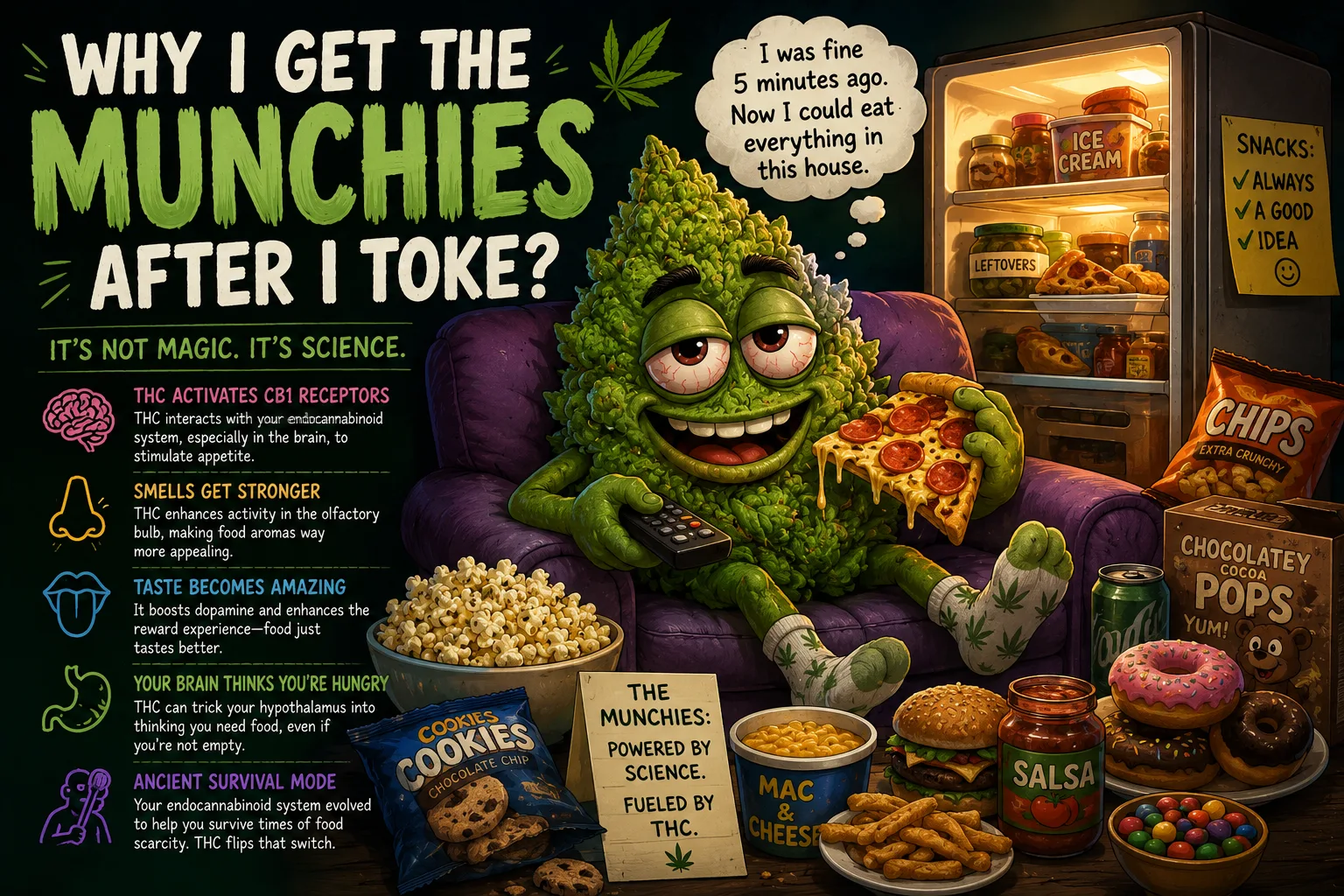
Have you ever finished a cannabis session and suddenly found yourself standing in front of the refrigerator wondering how a pizza, a bowl of cereal, and a bag of chips all ended up on your plate?
Welcome to one of cannabis culture’s most famous side effects: the munchies.
For decades, cannabis users have joked about emptying the pantry after a good session. But what many people don’t realize is that the munchies are backed by real science. This isn’t simply a matter of lacking self-control. When cannabis enters the body, it interacts with biological systems that directly influence hunger, smell, taste, and food enjoyment.
Let’s take a closer look at what’s actually happening inside your body when cannabis turns snack time into feast time.
What Are the Munchies?
“The munchies” is the nickname given to the increased appetite many people experience after consuming cannabis.
Some people notice mild cravings, while others suddenly become interested in every snack within a five-mile radius.
Scientists have studied this phenomenon for years and have found that the primary driver is THC (tetrahydrocannabinol), the main psychoactive compound found in cannabis.
Picture this: it’s your first time trying cannabis, and an hour later you’re standing in front of the open refrigerator, mesmerized by leftovers you barely noticed before. The smell of pizza seems irresistible, a handful of chips turns into half the bag, and suddenly mixing cookies with cereal sounds like a brilliant idea. If that experience feels familiar, you’re not alone. Why Do Cannabis Users Get the Munchies? The Science Behind Cannabis and Appetite
TOKER
THC and Your Endocannabinoid System
The human body contains a fascinating network known as the Endocannabinoid System (ECS).
This system helps regulate many important functions, including:
- Appetite
- Mood
- Sleep
- Memory
- Pain response
- Energy balance
The ECS contains receptors called CB1 receptors, which are found throughout the brain and nervous system.
When THC enters the body, it binds to these receptors and temporarily changes how certain signals are processed.
One of those signals happens to be hunger.
Cannabis Can Trick Your Brain Into Feeling Hungry
One of the primary areas affected by THC is the hypothalamus, the part of the brain responsible for regulating appetite.
Normally, your brain receives signals that tell you when you’re full.
THC can interfere with those signals.
As a result, your brain may start acting like it needs food—even when you’ve already eaten.
Your stomach might be saying:
“We’re good.”
Meanwhile, your brain is saying:
“Let’s order tacos.”
Food Smells Better After Cannabis
Have you ever noticed that food aromas seem stronger after consuming cannabis?
There’s a scientific reason for that.
Research suggests THC can increase activity in parts of the brain involved in processing smells.
Since smell plays a major role in appetite, enhanced aromas can make food seem far more appealing.
Suddenly, a simple bag of popcorn smells like gourmet cooking.
Food Tastes Better Too
The munchies aren’t only about hunger.
They’re also about pleasure.
THC influences dopamine pathways in the brain, which are associated with reward and enjoyment.
This means food often feels more satisfying and rewarding after cannabis use.
Many users report that:
- Sweet foods taste sweeter
- Savory foods taste richer
- Crunchy foods feel more enjoyable
- Favorite snacks become almost impossible to resist
Cannabis doesn’t just make you want food.
It often makes food more enjoyable once you start eating.
An Ancient Survival Mechanism
Scientists believe the Endocannabinoid System evolved partly to help organisms survive periods of food scarcity.
The body naturally produces compounds called endocannabinoids that help regulate hunger and energy balance.
THC closely resembles some of these natural compounds.
When THC activates the system, it can temporarily amplify biological pathways designed to encourage eating and energy storage.
In other words, cannabis is activating a system that helped our ancestors survive long before convenience stores and food delivery apps existed.
Why Do Some People Get Stronger Munchies Than Others?
Not everyone experiences the munchies in the same way.
Several factors can affect the intensity:
Genetics
Everyone’s Endocannabinoid System is slightly different.
Some people naturally respond more strongly to THC than others.
Cannabis Variety
Different cannabis strains contain different cannabinoid and terpene profiles.
Some varieties appear more likely to stimulate appetite than others.
Tolerance
Frequent cannabis consumers often report less intense munchies than newer users.
Environment
Watching food videos, hanging out with friends, attending social gatherings, or simply having snacks nearby can make cravings even stronger.
Can the Munchies Be Helpful?
Believe it or not, appetite stimulation is one of the most studied benefits of cannabis.
Researchers have explored cannabis as a way to help people maintain healthy food intake when appetite becomes a challenge.
The ability of THC to stimulate hunger has been one of the reasons scientists continue to study cannabis and the Endocannabinoid System.
The Downside of the Munchies
Let’s be honest.
The munchies can sometimes lead to eating choices that your future self might question.
Many people reach for foods high in:
- Sugar
- Salt
- Fat
- Empty calories
While an occasional snack attack isn’t the end of the world, regularly overindulging can contribute to unwanted weight gain.
That’s why many experienced cannabis consumers keep healthier snacks available, such as:
- Fresh fruit
- Nuts
- Yogurt
- Trail mix
- Air-popped popcorn
- Vegetables and hummus
Your taste buds stay happy, and your body will thank you later.
The Bottom Line
The munchies are far more than a cannabis stereotype.
They’re the result of THC interacting with the Endocannabinoid System, influencing hunger signals, smell, taste, reward pathways, and ancient survival mechanisms that help regulate energy balance.
The next time you find yourself staring into the refrigerator after a session, remember:
It’s not just your imagination.
It’s biology.
And now you know the science behind one of cannabis culture’s most famous experiences.
Continue Your Cannabis Education
At Kinnabis, we believe informed cannabis consumers make better decisions. Whether you’re exploring cannabis for wellness, cultivation, education, or curiosity, understanding how this remarkable plant interacts with the human body is part of the journey.
Stay tuned for more science-backed cannabis education from the Kinnabis Knowledge Base.